
Tech in the ClassroomArticles

Rethinking Screen Time in Math Classrooms

District leaders are rethinking the role technology should play in their math classrooms, and the question is whether digital tools are supporting active engagement, making student thinking visible, and strengthening the kind of classroom collaboration that good math instruction is grounded in.
Tanisha Makwana
June 1, 2026
4 min read

The role of technology in classrooms is under scrutiny right now, and district leaders are feeling it from every direction. Parents are showing up to board meetings with hard questions, auditors are being asked to reevaluate software bought during the pandemic, and lawmakers in more than a dozen states in 2026 alone have moved to reevaluate technology’s role in instruction.

A lot of that scrutiny is warranted. Programs that route students through gamified pathways, with no record of how they reasoned, are exactly the kind of use districts should be re-examining. At the same time, there is another reality district leaders are weighing. Teachers are stretched, and engaging every learner is difficult to do with pen and paper alone. NAEP is showing continued stagnation in math, and districts are looking to reverse the trend without losing the human core of teaching.

Digital programs can play a real role in that work if they are built to support the needs of instruction. The more useful question for district leaders is not whether students should be using digital tools during math, but what the program is doing to support productive engagement, student thinking, and the instructional goals of the math class. That reframing is the one the American Academy of Pediatrics (AAP) moved to in January 2026, when it shifted its guidance away from time-based limits and toward the quality and content of how screens are used. The distinction the AAP drew, and the one that districts can use, is between active and passive engagement.

What active and passive engagement look like in a math classroom

The kind of technology use that has drawn the most concern tends to follow a familiar pattern. A student opens an adaptive math program, moves through a sequence of multiple-choice questions, watches an animated explanation, and is eventually awarded a badge of completion. By the end of the session, neither the student nor the teacher has a record of how the student approached the problems. The screen is substituting instruction rather than supporting it.

Active engagement looks different. The student makes their reasoning visible while working through the problem, giving the teacher insight into their problem-solving process. Decisions about who needs support, what misconceptions to address, and when to bring the class back together can be made in real time. The majority of the math block stays where it has always belonged, in collaboration, discourse, and student-centered learning.

For district leaders evaluating where their current tools sit, a few questions are helpful to evaluate the role of technology in the classroom:

  • What is the program asking students to do while they are on the device?
  • What does the teacher learn about the conceptual understanding of their students?
  • How does the program contribute to discussion, collaboration, and instruction?
  • Does the tool strengthen the teacher’s role in the classroom?

The answers clarify which tools belong in the classroom and which ones may need to be reconsidered.

How Magma Math is built for active use

Magma Math is built to make student thinking visible, to the student, to their peers, and to the teacher. In practice, the tool works as a digital pencil and paper. Students solve problems on a canvas where they can write, draw, use digital manipulatives, and record voice explanations of their reasoning. Since students cannot submit an answer without showing how they arrived at it, the activity itself shifts. They are practicing mathematical reasoning rather than pattern-matching to reach the next correct response.

Decades of research on feedback point to the same conclusion. It changes learning most when it is specific to the student’s reasoning and reaches them close to the moment of difficulty (Hattie, Visible Learning). The immediate feedback a student receives in Magma responds to the specific approach they took, and the misconception driving the error is surfaced to the teacher. That is meaningfully different from a system that marks an answer wrong and routes the student to a generic lesson. The student receives hints based on their own thinking, which is the precondition for refining it.

Students are given room to struggle productively rather than being rushed toward the right answer. They can approach a problem in multiple ways, building deep understanding instead of short feedback loops where they guess and check.

The approach is producing measurable results in the districts that have adopted it. Alabaster City Schools in Alabama saw district-wide math proficiency grow by 40 percent in their first year of implementation. Independent research has confirmed statistically significant gains across multiple districts, and Magma Math holds an ESSA Tier II evidence rating, one of the highest evidence levels recognized under federal education research guidelines.

Bringing the classroom back together

The deeper concern in the screen time conversation is that digital tools are isolating students from one another and from their teachers. A student working through individualized content is not learning to think alongside their peers and teacher. This creates an environment where students work in isolation from one another, rather than a classroom engaged in shared inquiry.

When district leaders sit with this concern, it is often the one that lands hardest. A math classroom is meant to be a place where students learn to construct arguments, evaluate one another’s reasoning, and reason about how a problem should be approached. Very little of that work can happen on an overly gamified adaptive pathway.

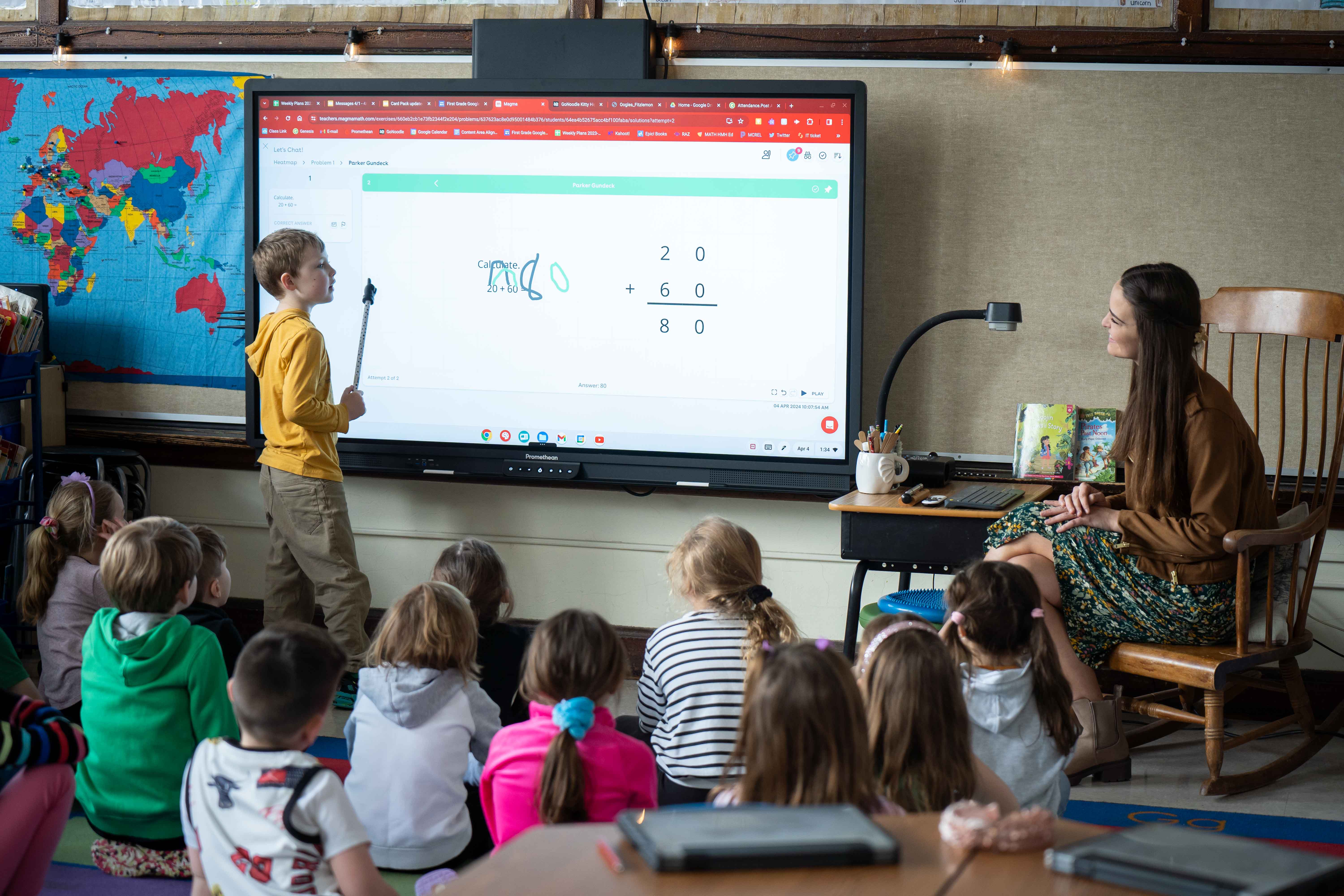
In Magma Math, conceptual understanding remains central. The program enables the teacher to put student reasoning at the front of the room and use it to anchor a class discussion, comparing multiple approaches anonymously rather than asking individual students to work on problems in isolation. This is the kind of mathematical discourse that NCTM, and frameworks like Peter Liljedahl’s Building Thinking Classrooms, identify as central to learning. It depends on building a culture where showing your work matters and where the teacher is able to see how every student is actually thinking.

Download ESSA Level III Report here
Tech in the ClassroomArticles

Rethinking Screen Time in Math Classrooms

District leaders are rethinking the role technology should play in their math classrooms, and the question is whether digital tools are supporting active engagement, making student thinking visible, and strengthening the kind of classroom collaboration that good math instruction is grounded in.
Tanisha Makwana
Jun 1

The role of technology in classrooms is under scrutiny right now, and district leaders are feeling it from every direction. Parents are showing up to board meetings with hard questions, auditors are being asked to reevaluate software bought during the pandemic, and lawmakers in more than a dozen states in 2026 alone have moved to reevaluate technology’s role in instruction.

A lot of that scrutiny is warranted. Programs that route students through gamified pathways, with no record of how they reasoned, are exactly the kind of use districts should be re-examining. At the same time, there is another reality district leaders are weighing. Teachers are stretched, and engaging every learner is difficult to do with pen and paper alone. NAEP is showing continued stagnation in math, and districts are looking to reverse the trend without losing the human core of teaching.

Digital programs can play a real role in that work if they are built to support the needs of instruction. The more useful question for district leaders is not whether students should be using digital tools during math, but what the program is doing to support productive engagement, student thinking, and the instructional goals of the math class. That reframing is the one the American Academy of Pediatrics (AAP) moved to in January 2026, when it shifted its guidance away from time-based limits and toward the quality and content of how screens are used. The distinction the AAP drew, and the one that districts can use, is between active and passive engagement.

What active and passive engagement look like in a math classroom

The kind of technology use that has drawn the most concern tends to follow a familiar pattern. A student opens an adaptive math program, moves through a sequence of multiple-choice questions, watches an animated explanation, and is eventually awarded a badge of completion. By the end of the session, neither the student nor the teacher has a record of how the student approached the problems. The screen is substituting instruction rather than supporting it.

Active engagement looks different. The student makes their reasoning visible while working through the problem, giving the teacher insight into their problem-solving process. Decisions about who needs support, what misconceptions to address, and when to bring the class back together can be made in real time. The majority of the math block stays where it has always belonged, in collaboration, discourse, and student-centered learning.

For district leaders evaluating where their current tools sit, a few questions are helpful to evaluate the role of technology in the classroom:

  • What is the program asking students to do while they are on the device?
  • What does the teacher learn about the conceptual understanding of their students?
  • How does the program contribute to discussion, collaboration, and instruction?
  • Does the tool strengthen the teacher’s role in the classroom?

The answers clarify which tools belong in the classroom and which ones may need to be reconsidered.

How Magma Math is built for active use

Magma Math is built to make student thinking visible, to the student, to their peers, and to the teacher. In practice, the tool works as a digital pencil and paper. Students solve problems on a canvas where they can write, draw, use digital manipulatives, and record voice explanations of their reasoning. Since students cannot submit an answer without showing how they arrived at it, the activity itself shifts. They are practicing mathematical reasoning rather than pattern-matching to reach the next correct response.

Decades of research on feedback point to the same conclusion. It changes learning most when it is specific to the student’s reasoning and reaches them close to the moment of difficulty (Hattie, Visible Learning). The immediate feedback a student receives in Magma responds to the specific approach they took, and the misconception driving the error is surfaced to the teacher. That is meaningfully different from a system that marks an answer wrong and routes the student to a generic lesson. The student receives hints based on their own thinking, which is the precondition for refining it.

Students are given room to struggle productively rather than being rushed toward the right answer. They can approach a problem in multiple ways, building deep understanding instead of short feedback loops where they guess and check.

The approach is producing measurable results in the districts that have adopted it. Alabaster City Schools in Alabama saw district-wide math proficiency grow by 40 percent in their first year of implementation. Independent research has confirmed statistically significant gains across multiple districts, and Magma Math holds an ESSA Tier II evidence rating, one of the highest evidence levels recognized under federal education research guidelines.

Bringing the classroom back together

The deeper concern in the screen time conversation is that digital tools are isolating students from one another and from their teachers. A student working through individualized content is not learning to think alongside their peers and teacher. This creates an environment where students work in isolation from one another, rather than a classroom engaged in shared inquiry.

When district leaders sit with this concern, it is often the one that lands hardest. A math classroom is meant to be a place where students learn to construct arguments, evaluate one another’s reasoning, and reason about how a problem should be approached. Very little of that work can happen on an overly gamified adaptive pathway.

In Magma Math, conceptual understanding remains central. The program enables the teacher to put student reasoning at the front of the room and use it to anchor a class discussion, comparing multiple approaches anonymously rather than asking individual students to work on problems in isolation. This is the kind of mathematical discourse that NCTM, and frameworks like Peter Liljedahl’s Building Thinking Classrooms, identify as central to learning. It depends on building a culture where showing your work matters and where the teacher is able to see how every student is actually thinking.

More episodes

No items found.
WaveWave